
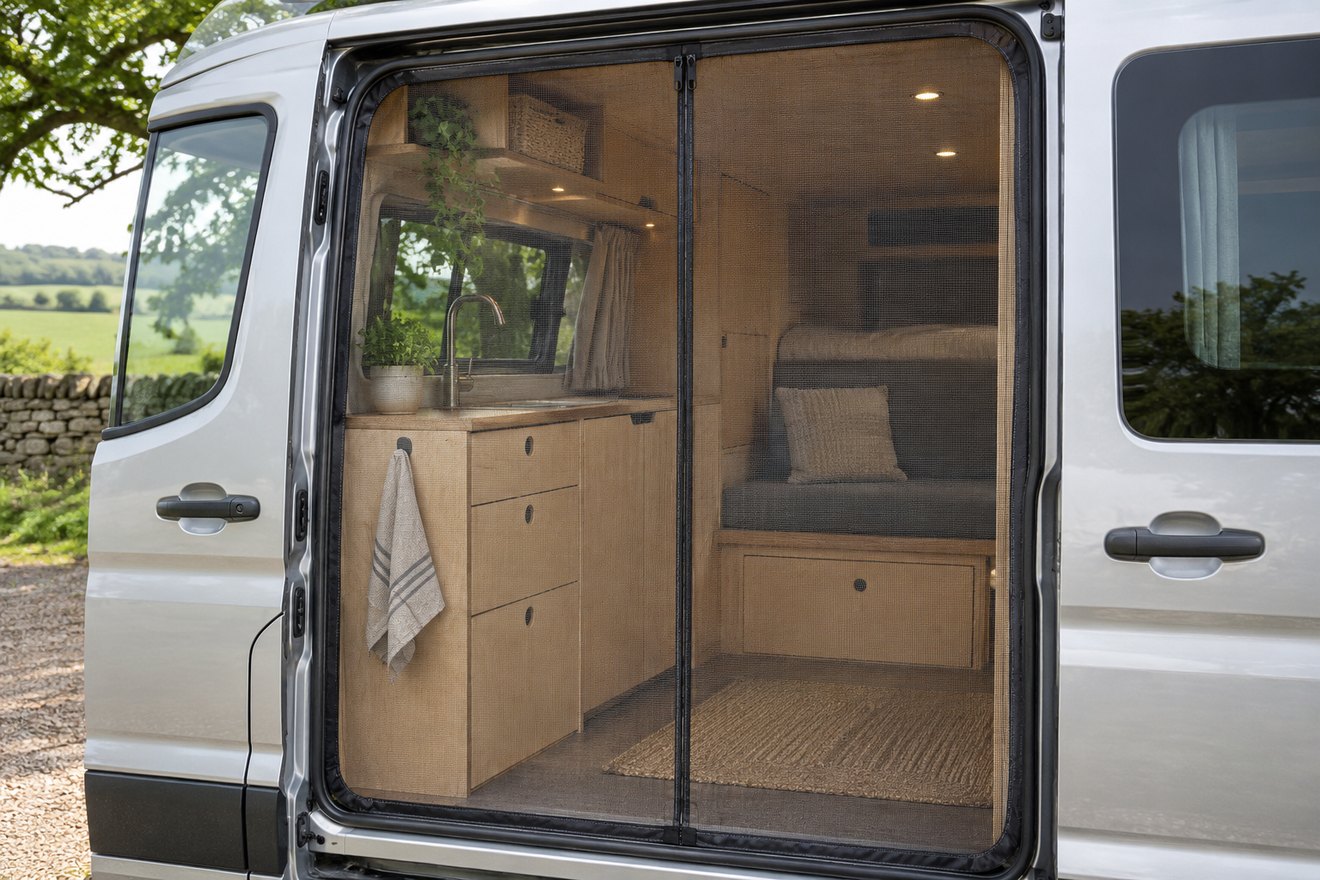
A campervan door fly screen lets the slider stay open for air when insects would usually send you indoors. The screen works best if you can walk through it in one movement with a cup, a lead or shopping in one hand. Try the attachment and opening arrangement before drilling for any permanent track.
Measure the finished doorway
Measure past lining, step trim and handles at the top, middle and bottom. A screen may need a different shape on doors with a pronounced lower curve or a cupboard beside the doorway. Use a paper template to check where the lower edge meets the threshold and whether a magnet or track will meet an appropriate surface around the opening.
Compare zip, magnetic and retracting designs
A zip can give a more controlled opening when the mesh is tensioned correctly. Magnetic edges can be convenient if your hands are full. A retracting design keeps the mesh out of the way while closed, although its casing and guide need space. Test whichever system you choose with the sliding door, inside handles and cab routes. Keep required ventilation and exits usable in every normal position.
Decide how you will stow a damp screen
Check that the rolled or folded mesh cannot catch in the door and that its fastening is secure for travel. Try the screen alongside your step and any awning tunnel. When it is wet, use a stowage spot that lets it dry safely afterwards. Fine mesh can restrict some airflow, so consider the usual wind and shade on the pitch.
FAQ
Will any universal mesh fit my slider?
Compare the shape and fixing positions as well as width and height. Gaps around the side trim quickly undermine a close-fitting panel.
Can the screen stay closed while I shut the sliding door?
Follow the product instructions and test slowly while parked. Give moving door parts and latches their full clearance.
Read our guide to planning a campervan side step for the next part of the build. You can also send your layout and measurements to NEVAN.