

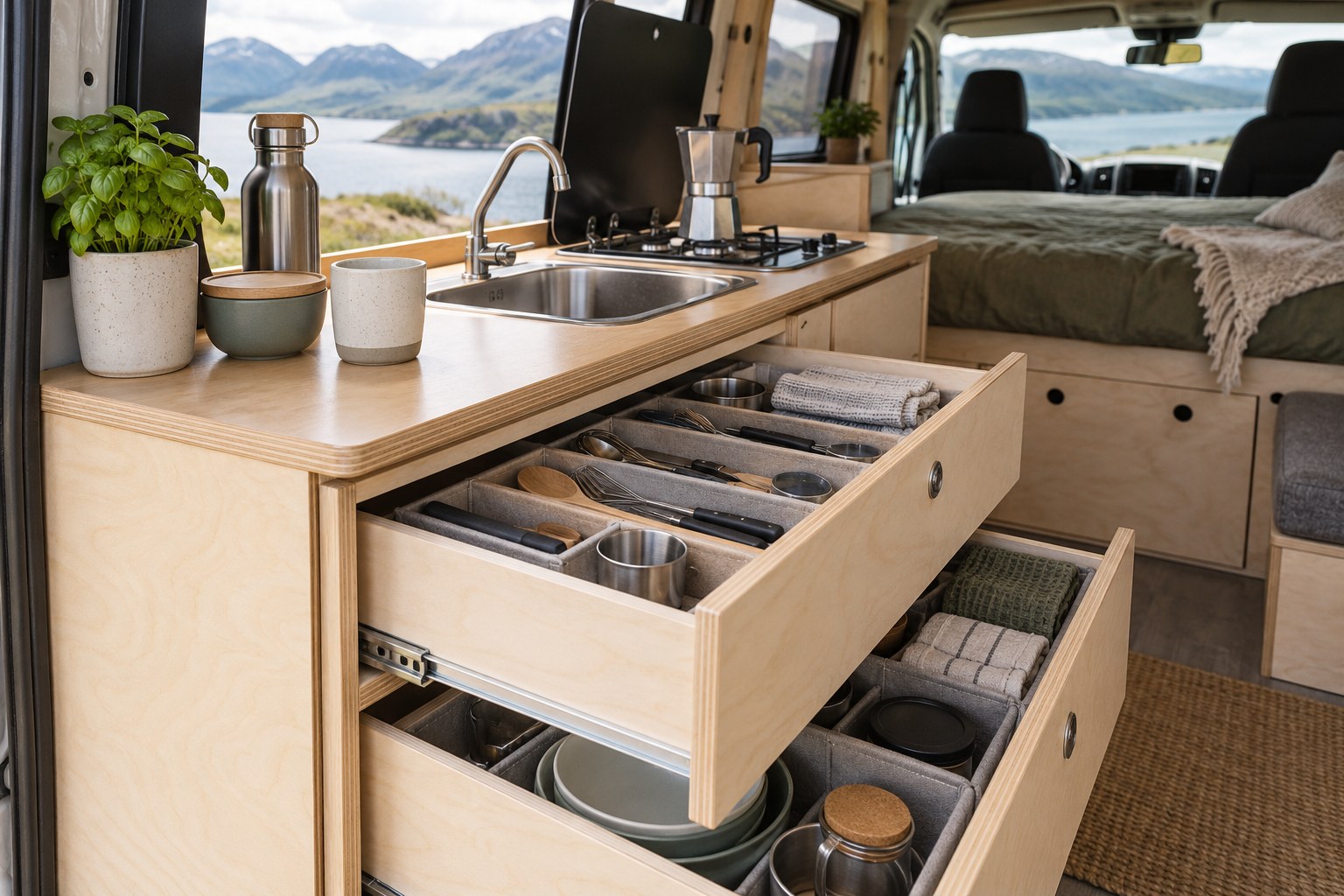
Campervan storage drawers make sense when they bring useful contents towards you. They become less helpful when opening one blocks the whole aisle or when a deep drawer hides small items in several layers. Begin with the things you want to store, then plan the cabinet around how you will reach them.
Separate ordinary interior drawers from large garage pull-outs. A kitchen drawer used ten times a day has a different job from a rear storage tray opened at a campsite.
Measure the contents before the cabinet
Group daily objects on a table: cutlery, pans, food containers or clothing. Measure the tallest and widest pieces in the orientation in which they will travel. Include handles and lids rather than relying on the size printed on the packaging.
Then compare those measurements with the drawer’s usable internal space. The cabinet width, drawer-front width and internal width are different measurements. Runners, sides and other fittings all take up space inside the outer cabinet.
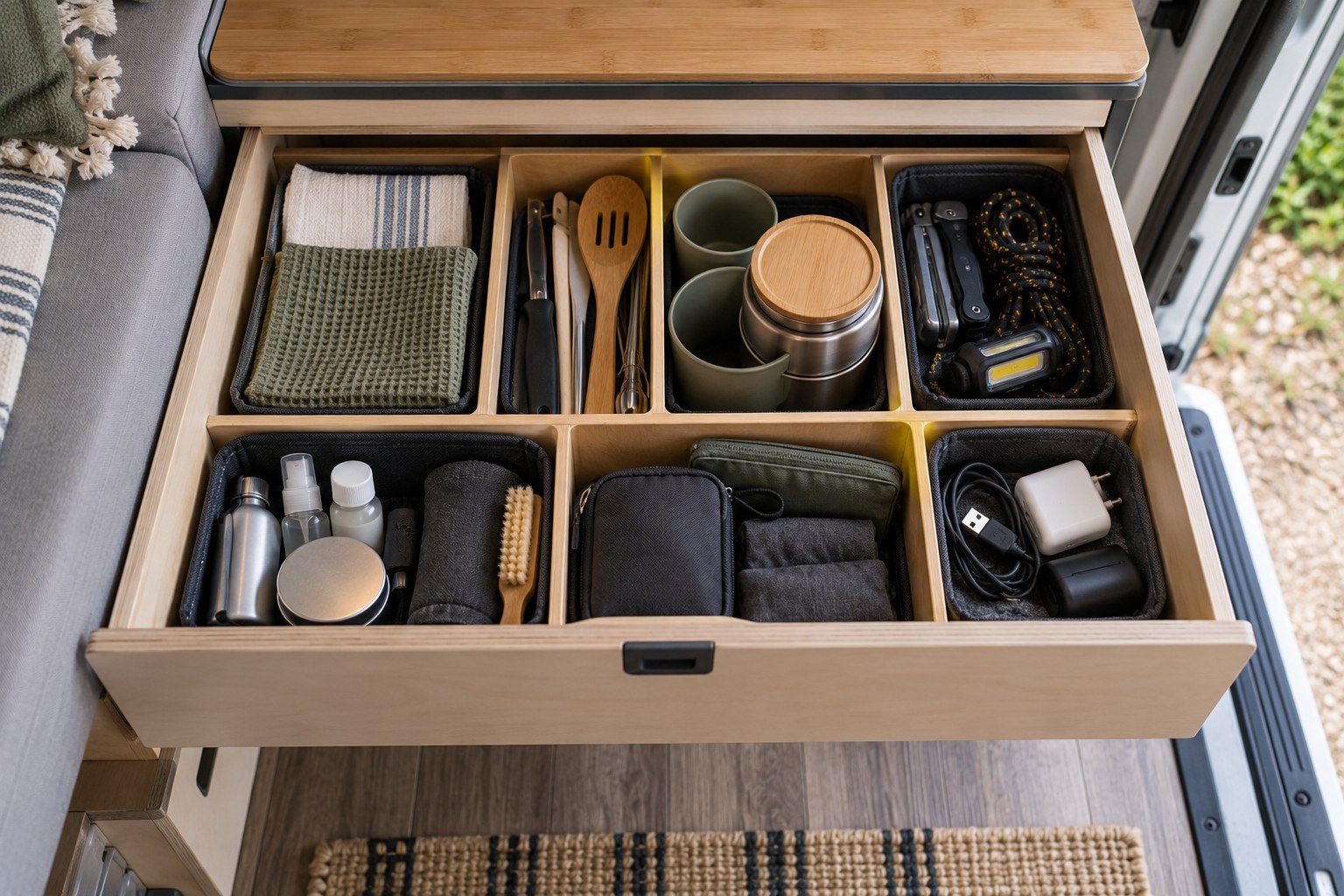
Draw the full opening on the floor plan
Mark the position of each drawer when fully extended. Include the person using it and the place where a second traveller might stand. Check the same drawing with the table fitted, bed made and any other door open.
Two drawers facing each other may be individually easy to reach but impossible to use together. You may accept that trade-off, provided the routine is clear. The problem is discovering it after both cabinets are installed.
Match drawer depth to the job
A shallow drawer can keep small items visible in one layer. Deeper storage suits larger objects, with an arrangement that prevents everything from becoming one mixed stack. Ask how far the drawer opens and how much of the back remains accessible.
- Keep frequently used items within an easy reach.
- Allow room to lift bulky objects out of the opening.
- Check the supplier’s load and fitting requirements.
- Choose suitable retention for travel.
Drawer inserts should follow the final internal measurements. Our guide to drawer inserts covers the next step once the drawer itself has been chosen.
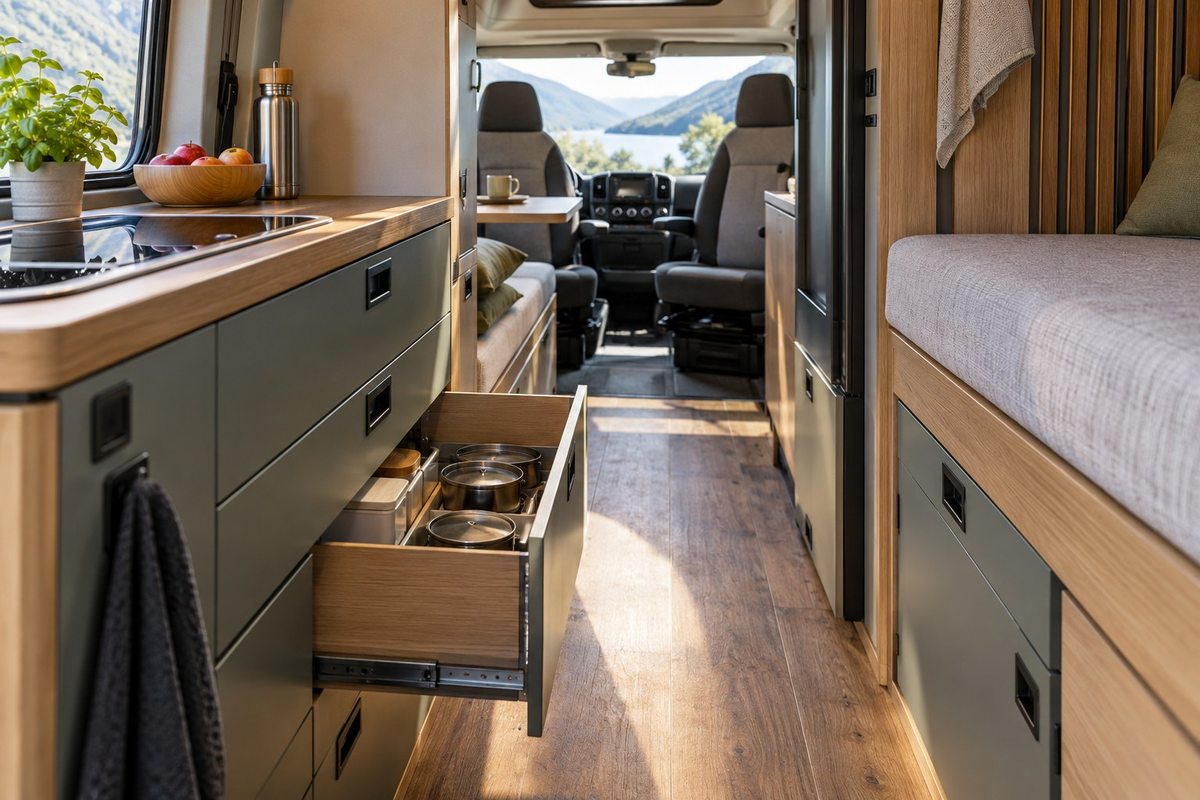
Look beyond the front panel
Ask how the drawer is removed for cleaning or service access, following the supplied instructions. Check whether a nearby wall, seat or doorway will prevent that removal in the finished van. Keep the necessary access route clear.
Also plan around equipment behind or beneath the cabinet. A drawer should not rely on occupying space reserved for appliance ventilation or maintenance. Show these boundaries to the furniture supplier and relevant installer before fixing the cabinet design.
Try a full daily sequence
Simulate making breakfast: reach a bowl, open food storage, take out a pan and put items back. Cardboard boxes and tape can stand in for drawers during planning. Notice whether the open drawer traps you between the kitchen and bed.
When comparing NEVAN kits, ask for the relevant internal dimensions and opening details. Knowing what fits and how it comes out is more useful than counting drawer fronts in a photograph.